Why Choosing the Right InfiniBand Switch Matters for AI Clusters
Artificial intelligence training workloads are fundamentally different from traditional enterprise applications. Training a large language model or a deep learning recommendation system requires thousands of GPUs working in parallel, exchanging data with each other millions of times per second. In this environment, the network is far more than just a pipe for moving data—it is the backbone that determines whether your GPU cluster achieves near-linear scalability or gets bogged down by communication bottlenecks that waste costly compute resources.
Distributed training imposes an all-to-all communication pattern that makes GPU clusters especially vulnerable to network congestion. In each training iteration, gradients must be synchronized across every participating node. If the network fails to keep up, GPUs end up idling while waiting for data—a phenomenon known as “tail latency” or “communication overhead.” This is precisely why a growing number of AI practitioners and HPC architects are turning to InfiniBand. Designed specifically for high-performance computing, InfiniBand delivers the throughput, latency, and in-network intelligence that Ethernet simply cannot match.
What Is an InfiniBand Switch
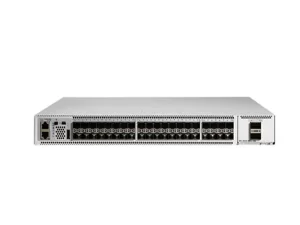
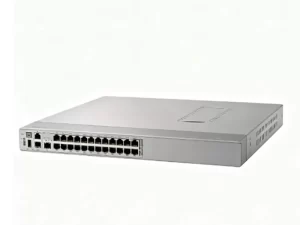
An InfiniBand switch is the foundational building block of an InfiniBand fabric. Unlike traditional Ethernet switches that handle general-purpose traffic, InfiniBand switches are designed from the ground up for high-performance computing and AI workloads. They provide extremely low latency, lossless transport, and advanced features like adaptive routing and congestion control that ensure predictable performance even under heavy load.
How InfiniBand Differs from Traditional Ethernet
The differences between InfiniBand and Ethernet are profound. InfiniBand operates on a channel-based model with built-in flow control, ensuring zero packet loss—a critical requirement for AI training, where dropped packets trigger retransmissions that wreak havoc on job completion times. Ethernet, by contrast, relies on TCP/IP or RDMA over Converged Ethernet (RoCE), which adds protocol overhead and introduces variability in latency. InfiniBand also offloads communication processing from the CPU, freeing compute resources for actual number-crunching.
Key Benefits of InfiniBand for AI and HPC Workloads
For AI and HPC, InfiniBand delivers three core advantages: ultra-low latency (sub-100 nanoseconds), high throughput (up to 400Gb/s per port), and in-network computing (the ability to offload collective operations like all-reduce to the switch itself). These capabilities translate directly into faster training times, higher cluster efficiency, and lower total cost of ownership.
7 Key Factors to Consider When Choosing an InfiniBand Switch
1. Network Speed and Bandwidth
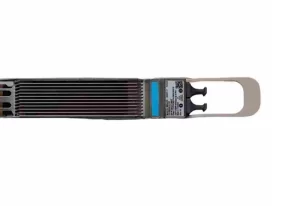
InfiniBand speeds have evolved through multiple generations: HDR (200Gb/s), NDR (400Gb/s), and the upcoming XDR (800Gb/s). While XDR is on the horizon, NDR is currently the most widely adopted generation for large-scale AI deployments. A 400G switch provides sufficient bandwidth for today’s most demanding GPU clusters, including NVIDIA DGX systems with multiple H100 or B100 GPUs per node. NDR delivers the headroom for massive data transfers, while avoiding the uncertainty of a next-generation standard that is still in its early stages.
For AI training, 400Gb/s is rapidly becoming the practical baseline. Modern GPU servers generate and consume data at unprecedented rates, and configurations below 400Gb/s often become a bottleneck that limits GPU utilization.
2. Port Density and Scalability
When evaluating InfiniBand switches, port density matters because it determines how many compute nodes you can connect within a single switch and how many switches you need to build a given fabric. Entry-level switches typically offer 32 ports, while high-density models provide 64 ports. For clusters exceeding 100 nodes, a 64-port switch dramatically simplifies the fabric topology, reducing the number of tiers and lowering overall latency.
High port density also translates into better rack space utilization. A 64-port switch in a 1U form factor can connect twice as many nodes per rack unit compared to a 32-port model, resulting in fewer switches, less cabling, simpler management, and lower power consumption per port.
3. Switching Performance and Latency
Not all switches are created equal when it comes to forwarding performance. A true non-blocking architecture ensures that every port can communicate at full line rate simultaneously, without any oversubscription. High-end NDR switches built on purpose-designed ASICs deliver full non-blocking throughput of 51.2Tb/s and forwarding rates exceeding 66.5 billion packets per second.
Equally important is latency. For AI training, where thousands of small messages are exchanged during collective operations, every nanosecond counts. Switches based on the latest generation of InfiniBand silicon achieve sub-100 nanosecond port-to-port latency, ensuring that communication overhead remains negligible relative to computation time. This ultra-low latency is what enables linear scaling from 100 GPUs to 10,000 GPUs.
4. In-Network Computing Capabilities (SHARP)
This is where InfiniBand truly differentiates itself from Ethernet. NVIDIA’s SHARP v3 (Scalable Hierarchical Aggregation and Reduction Protocol) enables the switch itself to perform collective operations like all-reduce, broadcast, and barrier synchronization directly within the network fabric. Instead of data flowing from GPU to GPU through the switch, the switch aggregates data internally and sends only the final result back to the GPUs.
SHARP v3 accelerates collective operations by up to 32× compared to software-based approaches, dramatically reducing the number of messages that traverse the network. For AI training, this means faster gradient synchronization, shorter iteration times, and significant reductions in total training time. Switches with SHARP v3 support are therefore particularly well-suited for organizations running large-scale distributed training jobs.
5. Management Model: Managed vs. Unmanaged
InfiniBand switches fall into two categories: managed (with an embedded Subnet Manager) and unmanaged (relying on an external Subnet Manager). This distinction is critical because it affects how you design, deploy, and scale your fabric.
Managed switches are suitable for smaller deployments where simplicity is paramount. However, for clusters with hundreds or thousands of nodes, a managed approach becomes a liability—the embedded Subnet Manager may lack the resources and visibility needed to optimize a large, dynamic fabric.
Unmanaged switches are designed for large-scale environments. They rely on an external Subnet Manager—typically running on a dedicated server or within a virtual machine—that centralizes fabric orchestration, provides full visibility, and enables advanced features like adaptive routing and congestion control across the entire fabric. This architecture scales seamlessly to 10,000+ nodes and is the preferred choice for top-tier supercomputing centers and cloud HPC providers.
6. Cooling, Power Efficiency, and Reliability
Data center deployments demand high reliability and energy efficiency. When selecting an InfiniBand switch, pay close attention to the following aspects:
Airflow direction – Ensure compatibility with your data center’s hot-aisle/cold-aisle layout. Common options include port-to-cable (P2C, front-to-rear) and cable-to-port (C2P, rear-to-front) airflow.
Power supply redundancy – Look for 1+1 or N+N redundant hot-swap power supplies. This ensures that a single PSU failure does not interrupt multi-day training jobs.
Fan redundancy – N+1 redundant hot-swap fan systems allow for maintenance without powering down the switch, supporting high availability.
Energy efficiency – 80+ Platinum or Titanium certified PSUs reduce power consumption significantly, lowering operating costs and environmental impact.
For mission-critical AI workloads, these redundancy features are non-negotiable. A single power supply or fan failure should never interrupt a training job that may run for days or weeks.
7. Compatibility with Existing Infrastructure
Many organizations already have investments in HDR, EDR, FDR, or even QDR InfiniBand equipment. When purchasing a new NDR switch, backward compatibility is an important consideration. Switches that support previous generations enable you to integrate them into existing fabrics without a forklift upgrade. This protects your capital investment and allows a phased migration to NDR speeds.
Additionally, compliance with industry standards such as IBTA 1.4, RoHS, Energy Star, and 80+ Platinum ensures regulatory and environmental requirements are met for global deployment.
Recommended InfiniBand Switch for Large AI Clusters
Why the Mellanox MQM9790-HS2F Is a Strong Choice
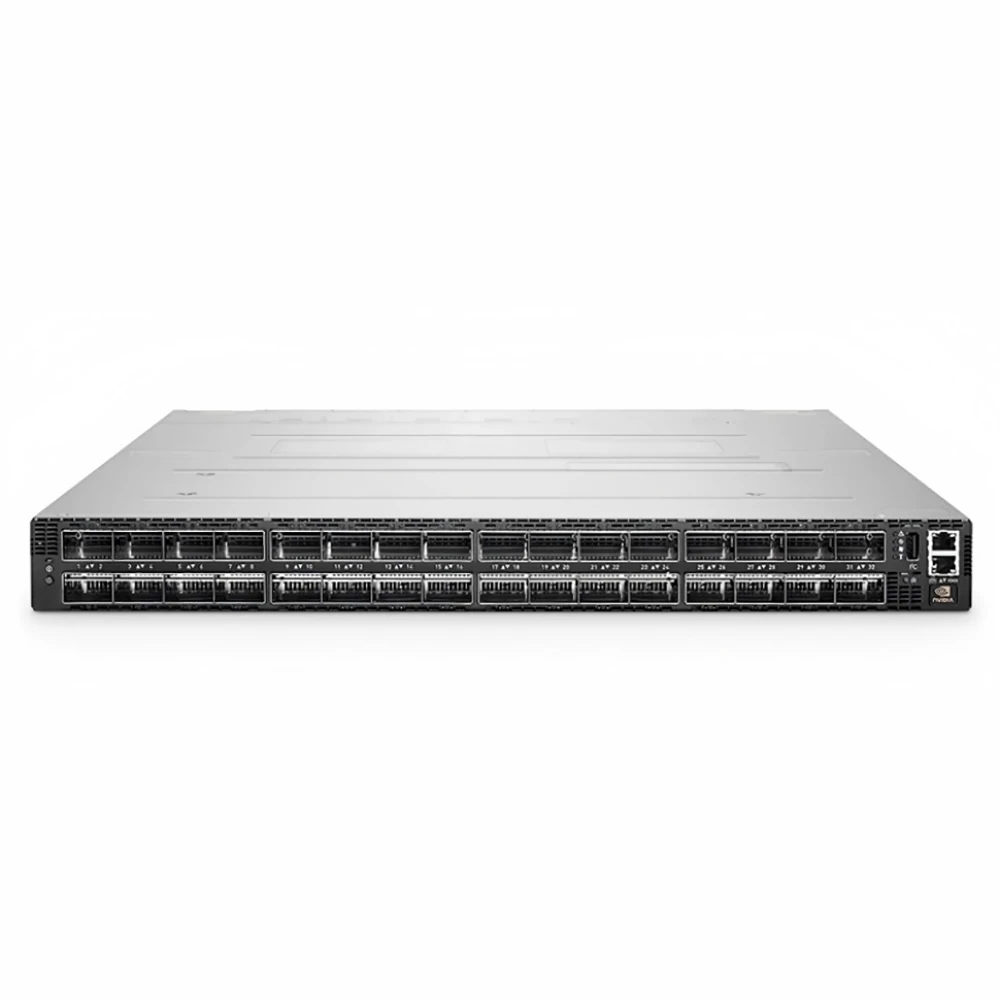
After evaluating all seven factors above, the Mellanox MQM9790-HS2F Quantum-2 NDR InfiniBand Switch emerges as one of the most capable options for large-scale AI and HPC deployments.
Built around the NVIDIA Quantum-2 ASIC and powered by an x86 Coffee Lake i3 CPU with 8GB DDR4 memory, this 1U switch delivers 64×400Gb/s NDR ports (via 32 OSFP connectors) with 51.2Tb/s of non-blocking throughput and sub-100ns latency. It includes SHARP v3 for in-network computing, accelerating collective operations by up to 32× and significantly reducing AI training time.
The unmanaged design with external Subnet Manager support makes it ideal for large fabrics, while the P2C airflow, 1+1 redundant 2000W AC power supplies, and N+1 hot-swap fans ensure reliability and energy efficiency in production environments. Backward compatibility with HDR, EDR, FDR, and QDR ensures seamless integration with existing infrastructure.
Whether you are building a supercomputing center, a cloud HPC service, or a GPU cluster for large language model training, the MQM9790-HS2F offers the density, performance, and advanced features that modern AI workloads demand.
Common Mistakes When Buying an InfiniBand Switch
Choosing ports based only on current requirements – AI clusters grow rapidly. Buying a 32-port switch for a 50-node cluster may force you to add a second tier sooner than expected, increasing latency and cost.
Ignoring scalability – Managed switches with embedded Subnet Managers may not scale beyond a few hundred nodes. For long-term growth, choose an unmanaged switch that supports external Subnet Managers.
Overlooking latency – Bandwidth is important, but latency matters just as much for collective communication. A switch with 200ns+ latency will underperform in AI training compared to sub-100ns alternatives.
Forgetting management architecture – Ensure your Subnet Manager strategy aligns with your cluster size. For large fabrics, external Subnet Managers provide better visibility and control.
Ignoring power redundancy – A single power supply failure can halt a training job running for days. Always opt for 1+1 or N+N redundant PSUs in production environments.
Frequently Asked Questions
Is InfiniBand better than Ethernet for AI?
Yes, for large-scale distributed training, InfiniBand consistently outperforms Ethernet due to lower latency, lossless transport, and in-network computing capabilities like SHARP. While Ethernet with RoCE is an option, it introduces variability and higher CPU overhead that can reduce GPU utilization.
What speed do AI clusters need?
For modern GPU clusters with H100 or B100 GPUs, 400Gb/s NDR is the recommended baseline. It provides sufficient bandwidth for all-to-all communication patterns and ensures GPUs remain fully utilized during training.
How many ports should an InfiniBand switch have?
For clusters up to 50 nodes, 32 ports may suffice. For larger deployments, 64-port switches reduce fabric complexity and lower total cost of ownership.
Can an unmanaged InfiniBand switch be used in enterprise environments?
Absolutely. In fact, unmanaged switches are the preferred choice for enterprise and cloud HPC environments where centralized management, scalability, and advanced routing features are required.
Conclusion
Choosing the right InfiniBand switch for your AI cluster is a decision that will impact performance, scalability, and operational cost for years to come. Speed, port density, latency, in-network computing, management architecture, reliability, and compatibility are all critical factors that deserve careful evaluation.
The Mellanox MQM9790-HS2F is a mature, high-density NDR solution built on NVIDIA’s Quantum-2 ASIC. With 64×400Gb/s ports, sub-100ns latency, SHARP v3 acceleration, and a robust redundant design, it provides the foundation for building high-performance, large-scale GPU clusters that can tackle today’s most demanding AI and HPC workloads. If you are planning a new deployment or upgrading an existing InfiniBand fabric, the MQM9790-HS2F mellanox IB switch is worthy of serious consideration. If you are interested in the MQM9790-HS2F, please feel free to contact us for more information and a quote.