1. Introduction
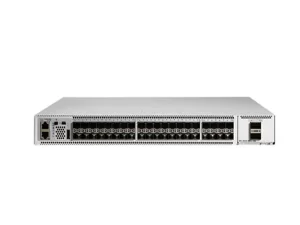
Data center switches need to meet relatively stringent requirements. For example, they have throughput capabilities of up to several terabits per second (Tbps), latency down to microseconds, high port density in a compact space, and high reliability ensured by redundant power supplies and fans. Modern data centers host critical applications—such as virtualization, AI/ML, and distributed storage—that generate massive volumes of inter-server traffic. Therefore, an excellent switch must be able to process this traffic efficiently without packet loss or latency. In this guide, we will use the Cisco Nexus N9K-C93180YC-FX3 as an example to provide a detailed explanation, with the goal of helping you learn how to select the right data center switch for your needs.
2. Types of Data Center Switches
Traditional modern data center networks employ a three-tier architectural model, consisting of core, aggregation, and access layer switches. Core layer switches form the network backbone and are responsible for connecting to the Wide Area Network (WAN) or the Internet. Aggregation layer switches are primarily responsible for implementing policies and routing functions. Access layer switches connect directly to servers and are typically deployed at the top or end of the racks. However, this architectural model can lead to unpredictable network latency, as data traffic may need to traverse all three layers sequentially—flowing from the access layer to the aggregation layer, then to the core layer, and subsequently returning along the same path. Such a transmission path involves an excessive number of hops.
Modern data centers use a two-tier spine-leaf architecture.
Modern data centers employ a two-tier “Spine-Leaf” architecture, replacing the traditional three-tier model. In this configuration, the “Spine” layer acts as the network backbone, while the “Leaf” layer connects directly to the servers; every Leaf switch connects directly to every Spine switch, separated by a distance of just “one hop.” In this manner, network latency remains fixed and extremely low (approximately 1 microsecond), while all links can simultaneously forward traffic without congestion, thereby enabling more efficient utilization of bandwidth.
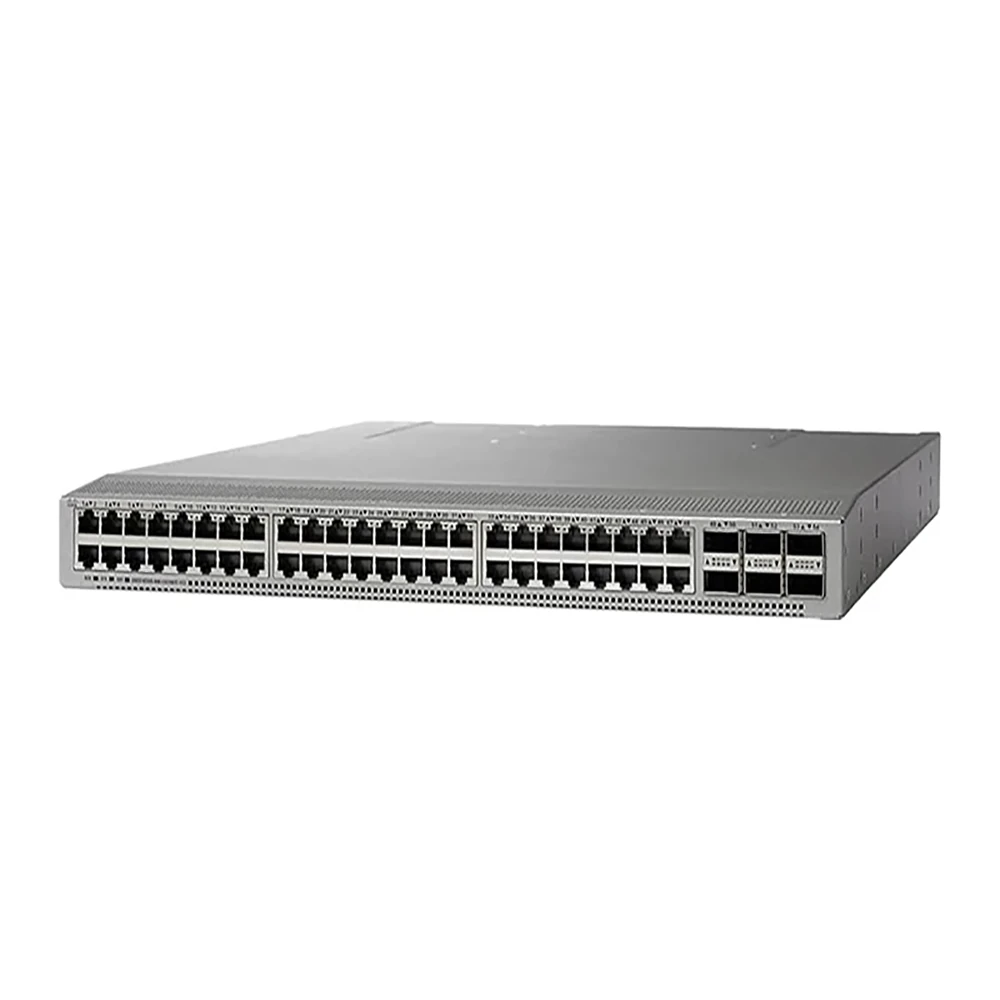
Example – Cisco Nexus N9K-C93180YC-FX3 as a Leaf Switch:
48 ports at 1/10/25G connect to servers or storage.
6 ports at 40/100G connect to spine switches.
Total switching capacity: 3.6 Tbps.
Forwarding rate: 1.2 Bpps (billion packets per second).
This switch fits perfectly in a spine-leaf fabric, whether you use traditional routing (NX-OS) or an intent-based fabric (Cisco ACI).
3. Key Features of Data Center Switches (Explained with Real Specs)
Below, we introduce five important features.
3.1 Speed and Performance
To evaluate the performance of a switch, you should focus on the following three core metrics:Switching capacity, forwarding rate, and latency.
Taking the Cisco N9K‑C93180YC‑FX3 as an example:
Switching Capacity: 3.6 Tbps
3.2 Port Density and Form Factor
Port density means how many ports you get per rack unit (RU). Higher density saves rack space, power, and cooling costs.
Take Cisco N9K-C93180YC-FX3 as an example:
| Feature | Value |
| Form factor | 1RU |
| Downlink ports | 48 x SFP28 (100M/1/10/25G) |
| Uplink ports | 6 x QSFP28 (10/25/40/50/100G) |
| Multi-speed support | Yes – mix 1G, 10G, 25G, 40G, 100G on the same switch |
This density is industry-leading for a 1RU 25G switch. Many competitors only offer 32 x 25G ports in the same 1RU space.
3.3 Layer 2 vs Layer 3 Functionality
Layer 2 switching is suitable for small networks, whereas Layer 3 switching supports routing and VXLAN—features essential for Spine-Leaf architectures. The Cisco N9K-C93180YC-FX3 supports both modes simultaneously: NX-OS mode provides traditional Layer 2/3 switching, while ACI mode offers policy-driven, automated VXLAN and centralized management. Opting for a dual-mode switch protects your investment, enabling a seamless upgrade from a traditional network to ACI without the need to replace hardware.
3.4 Low Latency and Special Protocols
Certain applications—such as High-Performance Computing (HPC), GPU-cluster-based AI/ML training, and financial trading—cannot tolerate latency fluctuations. The Cisco switch supports RoCEv2, PTP, and SyncE capabilities tailored for 5G telecom profiles, while achieving lossless transmission through priority flow control mechanisms. Thanks to its cut-through architecture, latency remains consistently stable at approximately 1 microsecond, regardless of changes in traffic patterns.
3.5 Programmability and Automation
Manual CLI is no longer enough for hundreds of switches. Modern switches should offer:
Zero-touch provisioning (ZTP)
REST APIs / NETCONF / gRPC
Integration with automation tools (Ansible, Terraform, Python)
The Cisco Nexus N9K-C93180YC-FX3 works with Cisco DNA Center for assurance, analytics, and automation. It also exposes a full set of APIs.
Cisco, Juniper, and Arista lead the data center switch market. The Cisco N9K-C93180YC-FX3 beats competitors on latency (~1 μs vs 1.2–1.5 μs) and port density (48 x 25G in 1RU vs 32 x 25G). It also offers a unique dual-mode feature (NX-OS or ACI) – something no other vendor provides. Plus, it integrates seamlessly with Cisco DNA Center, ISE, and ThousandEyes if you already have Cisco gear.
4. Choosing the Right Data Center Switch for Your Needs
4.1 Scalability Considerations
Please carefully consider your current server speeds (1G/10G/25G), your future upgrade plans (upgrading to 25G/50G within three years), and whether you require a 100G backbone link. If you wish to retain ACI as a future option without the need to replace hardware, the Cisco N9K-C93180YC-FX3 is the preferred choice.
4.2 Budgeting for Your Switch
Budget includes hardware, optics, software, and power. The Cisco switch supports cheap DAC cables, third-party optics, hot-swappable 650W AC or 930W DC power supplies, and hot-swappable intake or exhaust fans. NX-OS has no mandatory license, and a high-density 1RU switch often pays for itself in rack space and power within 12 to 18 months.
4.3 Common Beginner Mistakes to Avoid
Common beginner mistakes include buying a switch with insufficient capacity causing packet loss, ignoring latency which breaks HPC and trading workloads, choosing fixed-speed ports that need replacement when servers upgrade, and forgetting automation interfaces. The Cisco N9K-C93180YC-FX3 avoids all these with 3.6 Tbps capacity, about 1 microsecond latency, multi-speed ports from 1G to 100G, and full APIs plus DNA Center for automation.
5. Future Trends in Data Center Switching (and How This Product Fits)
5.1 25G/100G as the New Normal
25G connectivity for servers and 100G connectivity between switches have emerged as the optimal choices today. The N9K-C93180YC-FX3 switch natively supports 25G/100G.
5.2 AI/ML and RDMA (RoCEv2)
AI training requires low latency and lossless transmission. This switch supports RoCEv2, PFC, and ECN—all of which are essential for GPU clusters.
5.3 5G and Edge Data Centers
5G needs precise timing (PTP, SyncE, 1PPS GPS). The data center switch includes telecom profiles for 5G RAN aggregation.
5.4 Automation and AIOps
Cisco DNA Center provides zero-touch provisioning, assurance, and analytics. The switch’s API programmability fits into modern CI/CD pipelines.
5.5 Green Networking
Achieving higher density within a 1RU footprint translates to fewer switches, lower power consumption, and a lower PUE value. The N9K-C93180YC-FX3 features a 650W AC power supply and high-efficiency fans.
6. Conclusion
Whether you are building a new spine-leaf fabric, upgrading from 10G to 25G, or planning to adopt ACI in the future, this switch gives you performance, density, and flexibility without compromise.If you are interested in our products, please feel free to contact us for a quote.