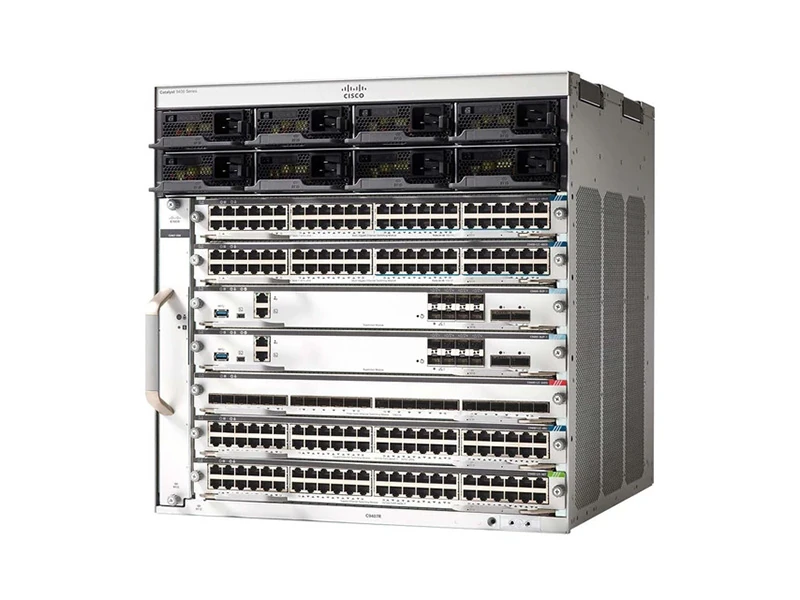
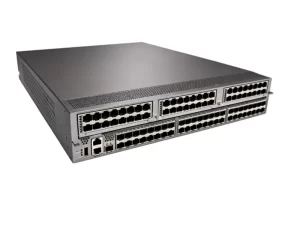
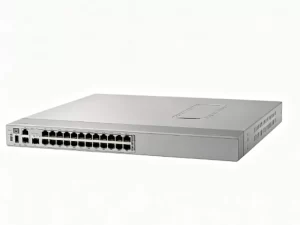
The Cisco Catalyst C9407R-E is a 7-slot modular chassis delivering ultimate scalability for enterprise networks. Supporting dual supervisors, 5 line cards (up to 240 ports), and Network Essentials, it ensures high availability and secure, high-density campus connectivity.
Quick Specs:
· Total Slots: 7 (2 for Supervisors, 5 for Line Cards)
· Max Port Density: Up to 240 Gigabit/mGig ports
· High Availability: Dual Supervisor & up to 8 Power Supplies
· Software: Cisco IOS XE Network Essentials
· Form Factor: 10RU Rack-mountable
Comprehensive Product Overview
The Cisco Catalyst C9407R-E is the workhorse 7-slot chassis of the premier Catalyst 9400 Series modular platform. Purpose-built for intent-based networking, this chassis is engineered to serve as a highly resilient and scalable aggregation or access-layer switch for medium-to-large enterprise campus networks. By separating the chassis hardware from the intelligence (Supervisor Engines) and connectivity (Line Cards), the C9407R-E provides unparalleled investment protection. Network architects can scale from dozens to hundreds of Gigabit, Multigigabit (mGig), or fiber ports, upgrade system bandwidth, and deliver massive UPOE+ power simply by swapping modules—all without ever removing the 10RU chassis from the server rack. This “-E” bundle includes the foundational Network Essentials software license.
Key Features & Business Benefits
Massive Scalability: With 5 dedicated slots for operational line cards, the chassis supports up to 240 non-blocking 10/100/1000 or Multigigabit ports. This allows businesses to consolidate multiple Top-of-Rack (ToR) switches into a single, centrally managed modular system.
Enterprise-Grade High Availability: Designed for zero-downtime environments. It supports dual redundant Supervisor Engines in Slots 3 and 4, enabling Non-Stop Forwarding and Stateful Switchover (NSF/SSO) during hardware failures or software upgrades.
Superior Power Redundancy: The chassis features 8 redundant power supply bays. When fully populated, it can effortlessly deliver 90W Cisco UPOE+ across hundreds of ports to power advanced Wi-Fi 6E/7 Access Points, LED lighting, and IoT devices.
Advanced Thermal Management: Equipped with a dual-serviceable, field-replaceable fan tray utilizing N+1 redundant fans. It ensures optimal front-to-back airflow, maintaining peak performance under maximum traffic loads.
Secure & Automated Foundation: Operates on the open, programmable Cisco IOS XE software. It natively supports MACsec AES-256 encryption, Encrypted Traffic Analytics (ETA), and seamless integration with Cisco DNA Center for zero-touch provisioning.
Technical Specifications
Specification
Details for C9407R-E
Product Series
Cisco Catalyst 9400 Series
Chassis Type
7-Slot Modular Chassis
Supervisor Slots
2 dedicated slots (Slots 3 and 4)
Line Card Slots
5 dedicated slots (Slots 1, 2, 5, 6, 7)
Software License
Cisco IOS XE Network Essentials (Perpetual)
Maximum Port Density
Up to 240 ports (with five 48-port line cards)
System Bandwidth
Scalable (Dependent on installed Supervisor Engine)
Power Supply Slots
Up to 8 redundant AC/DC power supply bays
Fan Tray
1 field-replaceable fan tray (N+1 redundant fans)
Rack Units (RU)
10 RU
Dimensions (H x W x D)
17.41 x 17.30 x 16.30 in. (44.22 x 43.94 x 41.40 cm)
Ideal Application Scenarios
Large Enterprise Campus Access: The perfect access-layer hub for large office buildings, capable of securely connecting and powering 240 employee workstations, VoIP phones, and security cameras from a single management point.
Building Distribution/Aggregation Layer: Positioned in a central telecom room, it can aggregate traffic from dozens of smaller Catalyst 9200/9300 edge switches using 10G or 25G fiber line cards, routing it efficiently to the network core.
High-Density Wireless Environments: When populated with Multigigabit (mGig) and UPOE+ line cards, it provides the massive power and bandwidth required for university campuses or stadiums upgrading to Wi-Fi 6E and Wi-Fi 7.
Required Components (Build Your BOM)
Critical Note: The C9407R-E is a foundational chassis bundle. To create a fully operational switch, the following ecosystem components must be ordered: · Supervisor Engines: At least one Catalyst 9400 Supervisor (e.g., C9400-SUP-1, C9400-SUP-1XL-Y, or C9400-SUP-2). Two are recommended for HA. · Line Cards: 1 to 5 business line cards (e.g., C9400-LC-48U for PoE/copper, C9400-LC-48XS for 10G SFP+). · Power Supplies: Multiple power supplies depending on PoE requirements (e.g., C9400-PWR-3200AC). · Cisco DNA License: A mandatory 3, 5, or 7-year DNA term subscription must be attached at the time of purchase.
Frequently Asked Questions (FAQ)
Q1: What is the difference between the C9404R and the C9407R?
A1: The main difference is physical size and capacity. The C9404R is a 4-slot chassis (7RU) supporting up to 96 ports. The C9407R is a larger 7-slot chassis (10RU) supporting up to 5 line cards, allowing for a maximum of 240 ports. Both support dual Supervisor Engines.
Q2: Which slots are used for the Supervisor Engines in the C9407R-E?
A2: In the 7-slot chassis, the Supervisor Engines must be installed in the two center slots: Slot 3 and Slot 4. Slots 1, 2, 5, 6, and 7 are strictly reserved for operational Line Cards.
Q3: Does the “-E” version support BGP and advanced routing?
A3: No. The “-E” signifies the inclusion of the Network Essentials license, which covers advanced Layer 2 and basic Layer 3 routing (like OSPF routed access and static routing). For full enterprise routing (BGP, full OSPF, IS-IS) and Cisco SD-Access capabilities, you need the Network Advantage (“-A”) license.
Q4: Can I use older Catalyst 4500-E line cards in this chassis?
A4: No. The Catalyst 9400 Series utilizes a completely new, next-generation backplane and architecture. It is not backwards compatible with legacy Catalyst 4500-E series supervisors, line cards, or power supplies.
Q5: How many power supplies do I need for the C9407R?
A5: The chassis has 8 power supply bays. You need at least one power supply to boot the system, but typically, enterprises install 2 to 4 power supplies (or more) to provide N+1 or N+N redundancy and to build a sufficient power budget for Power over Ethernet (PoE) line cards.